Herons
Where the Crawdads SingHerons are both subjects of Kya’s sustained observation and examples of the marsh’s intricate natural life. She watches them when formal schooling has failed her, learns to recognize even a single feather through years of attention, and describes their hunting with the precision of someone who has watched them at close range. Their presence helps establish the marsh not merely as Kya’s refuge, but as a place where patient looking can become a form of education.
Natural History and Hunting
Kya’s account of a great blue heron begins with its coloring: gray mist reflected in blue water. The comparison captures a bird that can disappear against its surroundings, leaving its ringed eyes as the most conspicuous sign of its presence. Herons are solitary hunters, capable of standing still for as long as necessary before snatching prey. They may also approach a catch one slow step at a time, or, more rarely, hunt on the wing, darting and diving with the beak pointed forward like a sword.
The description attends to different modes of movement rather than reducing the bird to a single emblem. Stillness, gradual approach, and sudden attack are all part of its repertoire. Kya’s image of the heron as a patient hunter follows from observed behavior, while the rare aerial pursuit complicates any simple impression of passivity. The bird is adapted both to waiting and to decisive action.
Kya’s Attention to Herons
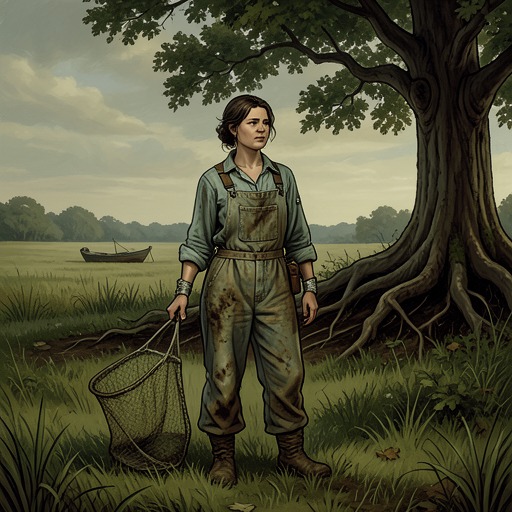
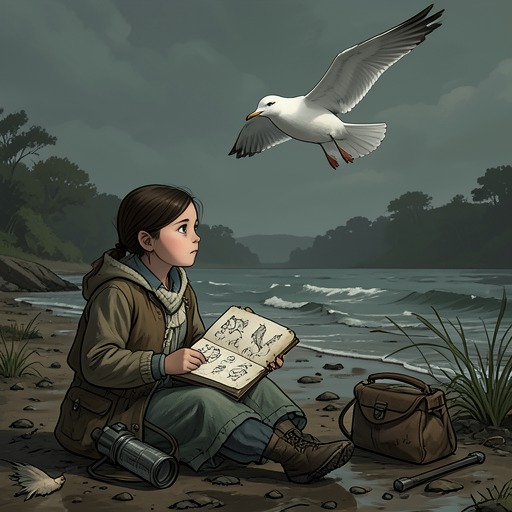
After leaving school and avoiding a return, Kya resumes heron watching and shell collecting, activities through which she believes she can learn. Her knowledge is practical and self-acquired: she has spent her life squatting eye to eye with Herons, and that accumulated attention enables her to identify a feather that someone less familiar with the marsh might mistake for an ordinary crow’s wing feather.
Her observation is not simply a substitute label for formal lessons. Kya distinguishes details of shape and placement, recognizing the feather as the heron’s eyebrow, the graceful curve above the eye that extends back from the head. The confidence of that recognition comes from repeated encounters with the living birds. The narrative thus makes her expertise visible through a small test: a fragment detached from the bird is enough for her to reconstruct its particular identity.
The Feather in Oak Clearing
In 1960, after noticing an older boy moving through the woods, Kya returns toward her shack by way of Oak Clearing. On a moss-covered stump she finds a thin black feather, five or six inches long, standing upright. She recognizes it at once as a great blue heron’s eyebrow feather, an exquisite piece of the coastal marsh she has never found before. Because she has just seen the boy nearby, she wonders whether he placed it there and whether he may still be watching. She backs away, runs home, and locks the screen door, which she seldom does because it offers little protection.
At dawn, however, her curiosity draws her back. She approaches the stump carefully, lifts the sleek, almost velvety feather, and gives it a special place in the collection spread across her wall, which ranges from tiny hummingbird feathers to large eagle tails. The discovery brings wonder alongside unease: Kya values the feather for what she knows it is, yet its unexplained placement makes it seem like a message from someone she does not know how to trust.
The next morning she delays her visit so that she will not encounter the boy. When she eventually returns, another feather—a long, curved white tropicbird tail feather—has appeared. That second discovery is not a heron feather, but it extends the scene’s emphasis on Kya’s discriminating knowledge: she can recognize a bird she has never seen locally as well as identify a familiar marsh species from a single distinctive plume. The collection preserves these differences rather than treating feathers as interchangeable curiosities.
Observation and Meaning
Kya’s attention to Herons belongs to a wider habit of learning by watching animals on their own terms. She watches the birds instead of merely collecting specimens, and her account follows their concealment, patience, and hunting choices. Elsewhere, she watches fireflies without trapping them, reasoning that observation can teach more than confinement. Together, these details present natural knowledge as an attentive practice: close enough to recognize minute distinctions, but willing to let the observed creature remain alive and independent.
The heron’s solitary patience also gives Kya’s watching a quiet formal parallel. Both are depicted through sustained attention in a landscape where a presence can be difficult to detect. The narrative does not claim that Kya consciously models herself on the bird; rather, the comparison arises from the shared emphasis on solitude, watchfulness, and survival. Herons matter because they are animals with particular ways of moving and hunting, and because learning those ways gives Kya a durable language for understanding the marsh she calls home.